
Change hits teens quite hard. A new school. A friend group that falls apart. Parents who split up. A body that suddenly feels strange. Adults call all this “growing up” but for a teen, it can feel like the floor is moving.
As a parent, remember that your teen does not overreact during life transitions. Their nervous system does its job. It reacts fast when life feels unsafe or unclear. Once we see teen life transitions this way, everything changes. We stop asking “why are you so upset.” We start asking “what does your body need right now.”
What Counts as a Life Transition for a Teenager?
Adults consider big events. Teens face many small ones too. Adolescent development is a string of transitions, one after another.
A few disturbing instances I see all the time:
- Starting middle school, high school, or college.
- Parents divorcing, remarrying, or splitting up.
- A close friendship ending or shifting.
- Puberty and a changing body.
- A move to a new home or city.
- A parent losing a job or facing illness.
- A first breakup or a first relationship.
Each one can spark real teenage stress. Many such transitions, when occurring, at once can push even a strong teen past their limit. This is what teen life transitions look like up close.
Why Do Teens Struggle So Much With Change?
A teen brain is still growing. The part that plans ahead and stays calm is not ready at this age. However, the part that senses danger is already strong. It fires fast and often.
Think of a phone running fifty apps at once. Everything slows down. Small alerts start to feel huge. That feels close to a teen’s worn out nervous system . It happens during a big change. A hard test can feel like danger to the body. So can an awkward hallway moment.
This is not a flaw. It is biology at work. Anxiety in teens often shows up right here. Their nervous system works hard to guard them. The threat is rarely a true danger. It is just new.
How Can You Tell If Your Teen Is Overwhelmed, Not Just Moody?
Teens rarely say, “I am struggling.” Their body speaks first. Watch for pulling away from things they used to love. Watch for changes in sleep or eating. Look for sudden crankiness. Watch for grades that drop out of nowhere.
Try to read these as signals, not defiance. A slammed door often means “I have no words for this yet.” It does not mean “I do not respect you.” Learning the language of body sensations helps here too. Tight shoulders. A flat voice. Restless legs. These often say more than words do.
The Mind Body Connection Teens Do Not Know They Have
My approach is not like a lot of talk therapy. I believe the body knows as much as the mind does. This matters a lot for teens who cannot find the words yet.
Somatic therapy is simple at its core. It means tuning into your body’s wisdom with curiosity, not judgment. We do not just ask “what are you thinking.” We also ask, “what does that feel like in your body right now.” Some teens feel a tight chest before they can name anxiety. Others notice a clenched jaw before they know they are angry.
One tool I sometimes use is called parts work. I bring it in gently, only when it fits. The idea is simple. We all carry many parts of ourselves. A protective part. A scared part. A part that just wants to be seen. Parts work invites curiosity toward each part. It does not ask you to fight any part. Teens often find this less scary than they thought. It does not ask them to have every answer right away. This curiosity is the heart of good teen therapy.
How Does Therapy for Teenagers Help?
Good therapy for teenagers meets them where they are. It does not chase some textbook picture of where they should be. The goal is not to erase each hard feeling. The goal is real tools for life changes for teens. These tools bring more calm and less dread.
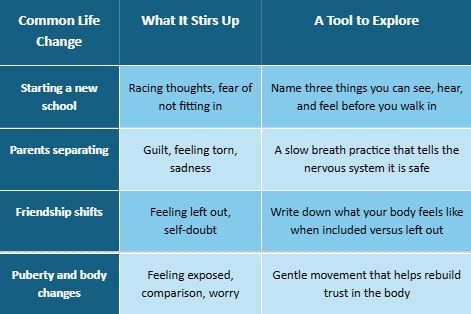
These are practices to explore together. They are not a strict checklist. Each teen finds a new mix that helps them most.
What Can Parents Do to Support a Teen Through Transition?
Family support matters as much as what happens in a therapy room. Parent child communication does not need to be perfect. It just needs to be steady and honest.
A few tools worth trying at home:
- Ask open questions instead of jumping to solutions.
- Sit with a hard feeling beside your teen instead of rushing to smooth it over.
- Keep a few daily routines steady during hard seasons.
- Notice body language shifts as a signal worth a gentle check in.
Emotional safety at home gives a teen somewhere soft to land. This matters most when life feels uncertain.

Building Resilience, Not Just Getting Through It
The goal of good teen therapy is not just getting by. It is emotional growth that lasts past the current change. Coping skills come from one hard season, like a school move. They tend to carry forward. They show up later in college, first jobs, and future relationships too.
Self-esteem, emotional resilience, and real support all build slowly. They grow through small steady moments, not one big breakthrough. This is real progress for life changes for teens. Healing happens one breath, one moment of awareness, and one step at a time.
Let’s Help Your Teen Find Solid Ground!
Is your teen going through a difficult phase right now? I would love to help in a real way. At Gabriela Breton Psychotherapy , we work with teens and families. We understand this kind of change. We bring warmth, patience, and zero judgment to each session.
Latest Post
- Why Life Transitions Can Feel Overwhelming for Teens—and How Therapy Helps
- Is Your Teen Struggling Emotionally? Here’s How to Build Lasting Resilience
- Trauma Sensitive Yoga: How Mindful Movement Helps Your Nervous System Feel Safe
- Couples Therapy: Strengthen Communication, Rebuild Trust & Reconnect
- Ketamine Assisted Psychotherapy: A Gentle Path Through Depression, Anxiety, and Trauma
- Beyond the Couch: How My Teen Therapy Can Help You Navigate Life
- How I Work With Individual Therapy Clients: Beyond Talk Therapy