
Trauma can make your own body feel like a dangerous place.
I observe this in my practice on a daily basis. Those who bear the burden of chronic stress or trauma become uncomfortably familiar with exhaustion as a baseline. Upon waking, they are greeted by tiredness. For them, the manifestation of body armor is constant.
Your nervous system feels like it is in overdrive, and so does your threat detection system, leaving you in an almost constant state of anxiety. One of my clients told me she feels like she lives in a “haunted house.” She says her anxiety is so bad she stays in her head to avoid the discomfort that comes from being physically present. She describes feeling like her body is an enemy that she has to carry around with her.
Talking about what happened is incredibly important. But sometimes, words simply fall short. Your body remembers the pain long after your logical mind tries to move on. The trauma gets trapped in your muscle fibers and your breath patterns.
That is exactly why I firmly believe in Trauma Sensitive Yoga.
What Is Trauma Sensitive Yoga?
Trauma sensitive yoga is a body based practice adapted specifically for people who carry trauma in their nervous systems. It grew out of research at the Trauma Center at the Justice Resource Institute in Boston, developed alongside the work of psychiatrist Bessel van der Kolk and yoga teacher, David Emerson.
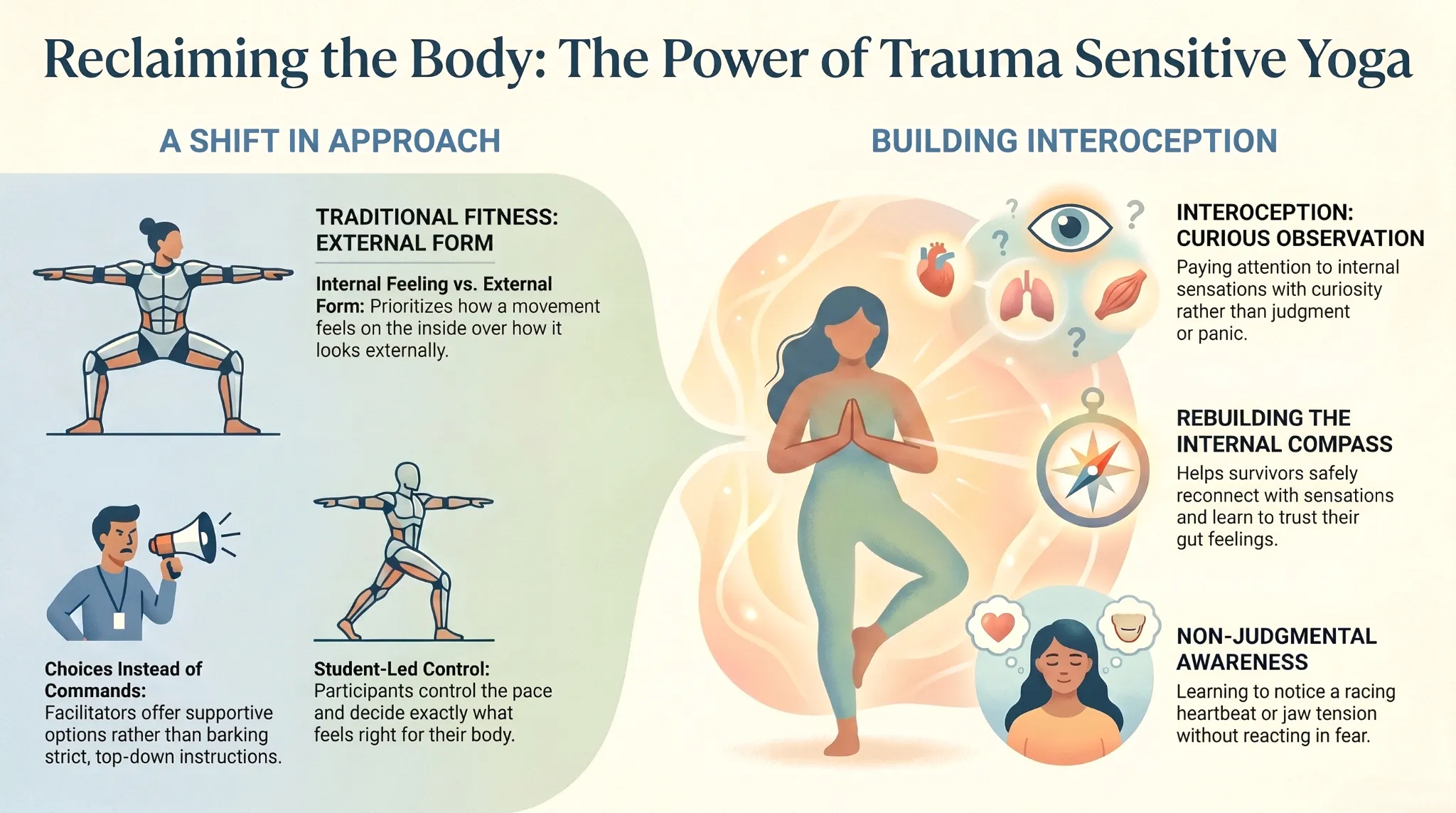
It looks like yoga, but it functions very differently. A standard yoga class often uses directive cues. “Hold this pose. Breathe here. Deepen your stretch.” Trauma sensitive yoga flips that entirely. Every instruction is offered as an invitation. “You might try this.” “Notice what feels available to you.” “There is no right way to do this.”
That shift in language isn’t cosmetic. For someone, whose nervous system has learned to scan for threats and defer to external authority, being given genuine choice in how their body moves can feel deeply significant.
Why Does Trauma Get Stuck in the Body?
Talk therapy is powerful. I believe that deeply. But there are things the talking brain can’t fully reach.
When you experience something frightening or overwhelming, your nervous system activates a survival response: fight, flee, or freeze. Under normal circumstances, that response completes itself and the body returns to baseline. But with repeated or unresolved trauma, that cycle doesn’t complete. The stress response stays switched on or gets locked somewhere in between.
People with PTSD often describe symptoms that feel entirely physical: hypervigilance, a startle response, numbness, or difficulty feeling present in their own skin. The body isn’t misbehaving. It’s doing exactly what it learned to do to keep you safe.
Trauma sensitive yoga works by gently, gradually teaching the nervous system something new. That stillness is possible. That movement can feel safe and you can be the one in charge of your own body.
How Is Trauma Sensitive Yoga Different From Standard Yoga Classes?
The differences matter more than most people realize. Here’s a side by side look at what sets this approach apart:
| Feature | Traditional Yoga | Trauma Sensitive Yoga |
| Instructor cues | Directive (“Do this now”) | Invitational (“You might explore…”) |
| Physical adjustments | Common, often without asking | Only with explicit, ongoing consent |
| Primary goal | Flexibility or fitness | Nervous system regulation |
| Session pacing | Structured sequence | Responsive and participant-led |
| Environment design | Can be stimulating or fast paced | Calm, predictable, sensory-aware |
That last column, specifically the emphasis on predictability, matters enormously. Trauma often lives in the unexpected: sudden sounds, unwanted touch, loss of control. A trauma sensitive yoga space actively works to remove those triggers from the environment itself.
What Can You Expect During A Session?
I want to be very clear about something. Sitting still on your mat is a valid practice.
You do not owe anyone a performance. You will be invited to try accessible movements. You might hear me saying, “If you want, you can try lifting your arms.” We use invitational language.
If you prefer to keep your arms down, that is a massive success. The magic happens when you realize you are in charge.
It is called choice-based movement. Trauma strips away your choices and leaves you feeling helpless. By making small choices about your own movements, you take your power back.
A Gentle Invitation To Reconnect!
This journey is uniquely yours and is best tread one breath and one moment of awareness at a time. It is a process that teaches patience and self-compassion. The best thing is that you do this at your own pace. There is no race. There is no finish line.
Your body is speaking. Please listen. If you are feeling called to try trauma sensitive yoga and create that essential connection, or reconnection between your body and your mind, I applaud you. Take that initiative. Follow your gut.
At Gabriela Breton Psychotherapy, we provide a space to feel and experience this process of healing. You deserve to feel at home and safe in your skin. That’s what we are here to support you in.
Frequently Asked Questions
Is trauma sensitive yoga the same as regular yoga?
No. Trauma sensitive yoga uses invitational language, prioritizes nervous system regulation over physical performance, and creates environments specifically designed to support people with trauma histories.
Do I need yoga experience to try trauma sensitive yoga?
Not at all. Trauma sensitive yoga welcomes complete beginners and newcomers to movement practices. Sessions center around accessibility and genuine choice, not prior yoga experience or physical ability.
Can trauma sensitive yoga replace therapy?
It works best as a complement to therapy, not a replacement. Many find it deepens therapeutic work by addressing the body based dimensions of trauma.
How long does it take to feel the benefits of trauma sensitive yoga?
Everyone’s timeline differs. Some people notice subtle shifts after a few sessions. Deeper nervous system changes often emerge gradually with consistent, gentle practice over time.
Is trauma sensitive yoga safe for people with severe PTSD?
Yes, when facilitated by a trained practitioner. The approach is built specifically to minimize traumatization and offer people with complex, severe trauma histories a pathway to safety.
Latest Post
- Understanding Anxiety: How I Help Teens and Adults Work With the Mind and Body
- Understanding the ADHD Brain: Beyond Attention and Hyperactivity
- Why Life Transitions Can Feel Overwhelming for Teens—and How Therapy Helps
- Is Your Teen Struggling Emotionally? Here’s How to Build Lasting Resilience
- Trauma Sensitive Yoga: How Mindful Movement Helps Your Nervous System Feel Safe
- Couples Therapy: Strengthen Communication, Rebuild Trust & Reconnect
- Ketamine Assisted Psychotherapy: A Gentle Path Through Depression, Anxiety, and Trauma
- Beyond the Couch: How My Teen Therapy Can Help You Navigate Life
- How I Work With Individual Therapy Clients: Beyond Talk Therapy