
Life as a teenager today feels completely exhausting. I sit with young people every single day who carry massive invisible weights. You wake up, check your notifications, and immediately face intense pressure. Before we even talk about finding solutions, I want to validate how tiring this constant performance is. It is entirely normal if you feel drained.
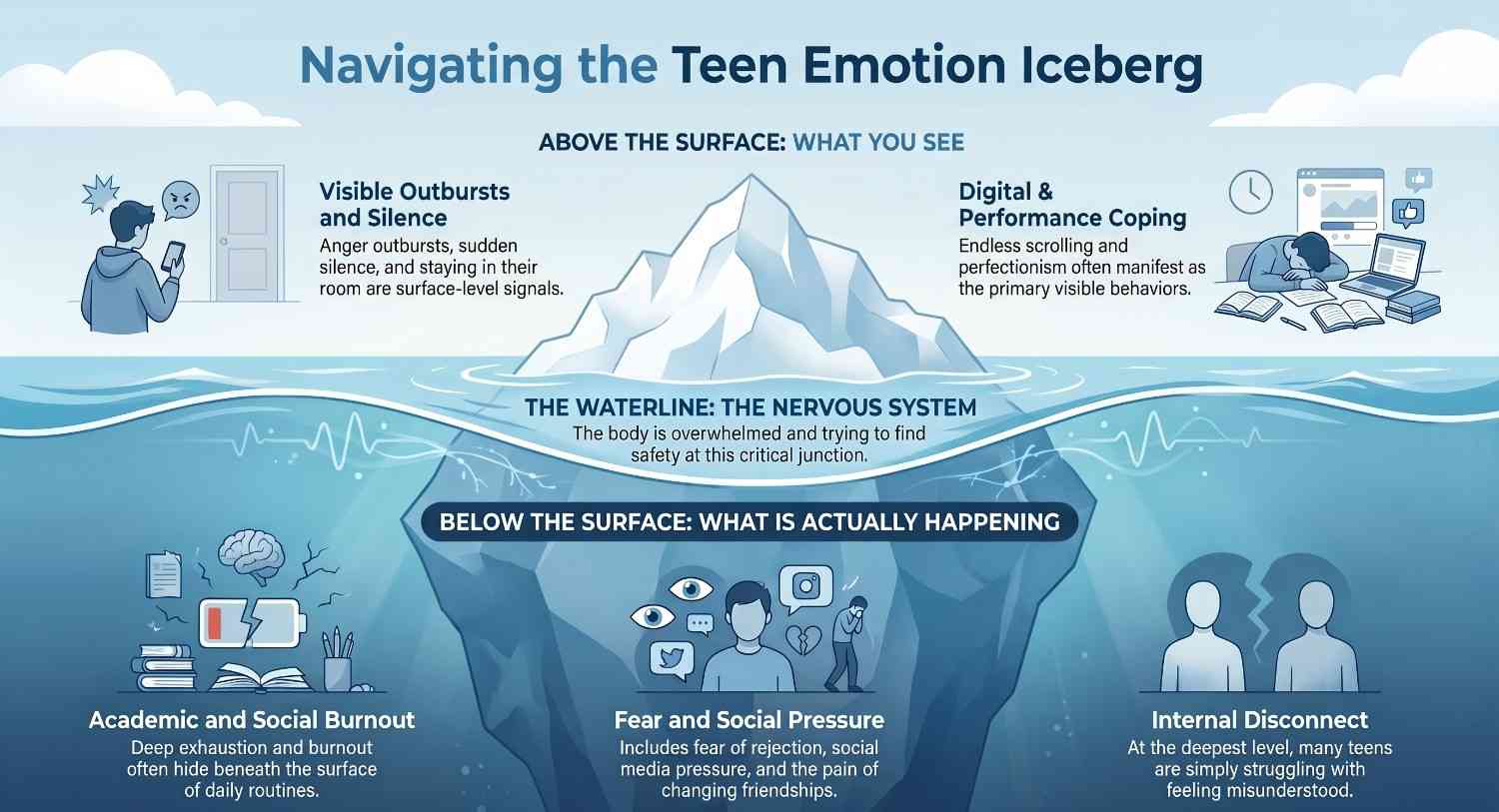
Good mental health is not just floating in your brain. It lives deeply inside your physical body. When you deal with serious stress, the nervous system almost like catches fire, in a way. You could notice a tight jaw, a heart beating fast, or a sudden stomach ache.
Why Is Being a Teenager So Stressful Today?
Adolescent development brings massive biological and social changes. Teenagers try to discover their identity while the expectations constantly shift around them. They manage school workloads like full-time adult jobs. They also manage complicated friendships that can alter overnight. It makes complete sense why so many young people experience burnout and doubt.
The human brain is still actively building its logic center right now. Because of this, you feel every single emotion at maximum volume. A conflict in the cafeteria does not just feel mildly annoying. It feels like a life-threatening emergency. Let’s look at why your body reacts this way.
I like to imagine your nervous system as a highly sensitive smoke detector. Right now, burnt toast sets off the same loud alarm as an actual fire. I want to help you gently recalibrate that alarm. We tune into your body’s wisdom to figure out what is actually a threat and what is just noise.
What Does Going Beyond the Couch Actually Mean?
You probably picture therapy as lying quietly on a leather sofa and a doctor nodding silently while you talk about your childhood. I ask my clients to leave that outdated image entirely behind. Real therapy is an active, dynamic laboratory. We do not just sit and analyze the past. We actively practice how to survive the present.
Going beyond the couch means taking the mind-body bridge straight into your daily routine. I want you to feel comfortable taking these tools into your classrooms, your sports practices, and your group chats. What this means for you is learning to translate clinical exercises into real life. It means knowing exactly how to ground yourself before a massive exam. It means finding physical ways to release anger instead of texting something you might regret. Therapy becomes a practical toolkit you carry everywhere. It helps a teen navigate chaos without losing their sense of self.
What Actually Happens in Teen Therapy?
Let me clear this. Therapy isn’t just sitting quietly on a couch while someone nods, like for an hour.
Teen therapy with me is active, practical, and kind of deeply personal too. It builds a space where you can come as you are, without polishing yourself for anybody. I actively work with teens navigating complex daily realities. This includes specialized support for those managing ADHD, OCD, Anxiety, and Depression. I tune my approach to match your personality, your pace, and what you are actually navigating right now. The whole idea is that you feel secure, steady, comfortable enough to start untangling the stuff that feels too heavy to hold solo. Making a teen feel physically and mentally secure is always my absolute first priority.
Here is a crucial piece of my approach. Teenagehood is exceptionally difficult. What we need in addition to practical coping skills is the ability to be incredibly kind to ourselves. I actively teach teens to be gentler and more compassionate to themselves when they make mistakes. I prioritize modeling that exact kindness and grace for them during every single session. We practice noticing the specific parts of your brain that judge, shame, or do not accept themselves. Treating these harsh internal parts with curiosity rather than fear completely changes how a teen feels about their own identity. I want to help you build a solid foundation of internal safety.
What Is CBT and How Does It Help Teens?
Cognitive behavioral therapy, or CBT, is a practice of noticing how your thoughts shape your feelings and how your feelings shape your actions.
Think of it this way. You bomb a presentation and your brain immediately says, “I am a failure and everyone thinks I am stupid.” That negative thought pattern creates a wave of shame that might make you avoid the next presentation entirely. CBT helps you catch that thought before it takes over your entire day.
I often describe CBT to teens as learning to fact check your own mind. You are not forcing yourself to think positively. You are exploring, with curiosity rather than judgment, whether the story your brain is telling you is actually true.
What Is DBT and Why Do Teens Benefit from It?
Dialectical behavior therapy, or DBT, is a practice built around learning to manage emotions without being swept away by them.
I use DBT to provide teens with real, usable coping skills for real situations. It works across these four areas:
- Distress tolerance
- Emotional regulation
- How to improve communication with others
- How to stay present in the moment without judgment
DBT is especially useful for those moments when a teen feels overwhelmed, experiences intense emotional struggles, or keeps making decisions they later regret. It does not ask you to stop feeling. It helps you feel without losing yourself in the process.

How My Therapy Help Teens Navigate Everyday Life
Here’s the thing about coping strategies. The good ones do not stay at my place. They travel with you. For example,
- A teen who learns to pause and name what they are feeling before reacting has a better shot at a hard conversation with a parent.
- Teens who understand their emotional regulation patterns start to recognize the warning signs before a situation escalates.
These are not abstract concepts. They are tools that change how you show up in your relationships, your classroom, and your own head. I have watched teens struggle for months and then find a genuine shift. Not because something outside of them changed, but because they started to understand themselves differently.
What Can Parents Do to Support Their Teen in Therapy?
If you are a parent reading this, your instinct to find support for your child is already the right one.
But I want to gently reframe your role in this process. Your job is not to fix. It is to accompany. Reducing stigma around mental health in your home, staying curious instead of reactive, and trusting the process even when progress feels slow, these choices matter more than you might realize. Giving your teen a space where they feel comfortable opening up at home, without fear of judgment, is one of the most powerful things you can offer alongside professional support.
Your Growth Does Not Have to Start with a Giant Leap
If any part of this post feels resonating with you, whether you are a teen trying to sort out your emotional struggles, or a parent searching for the right fit, I want to gently invite you to reach out.
At Gabriela Breton Psychotherapy, I support teens through a warm, body informed way of working. Here, I blend CBT, DBT, and somatic practices together to help you develop real coping skills for everyday life.
And remember, healing is not a final stop. It is something you practice, it keeps unfolding, one breath, one moment of mindful awareness, and one step at a time.
Frequently Asked Questions
How do I know if my teen needs therapy?
If your teen is withdrawing, struggling academically, showing intense mood changes, or expressing hopelessness, these are signs that professional mental health support could make a meaningful difference.
At what age can a teenager start therapy?
Therapy is accessible for adolescents as young as 12 or 13. Some therapists also work with preteens. What matters most is finding the right fit for your child’s specific needs.
What type of therapy works best for teenagers?
CBT and DBT are among the most researched approaches for teens. Many therapists blend methods, tailoring their work to each teen’s personality, coping needs, and emotional struggles.
Do parents attend these private therapy sessions?
Sessions usually remain strictly private to protect deep trust. I occasionally invite parents in to share helpful at-home coping practices and build much healthier family connection dynamics.
Can therapy help a teenager who is reluctant to go?
Yes. Therapists are trained to meet resistance with patience rather than pressure. Often, a few sessions of simply feeling heard can shift a reluctant teen’s relationship with the process.
Latest Post
- Why Life Transitions Can Feel Overwhelming for Teens—and How Therapy Helps
- Is Your Teen Struggling Emotionally? Here’s How to Build Lasting Resilience
- Trauma Sensitive Yoga: How Mindful Movement Helps Your Nervous System Feel Safe
- Couples Therapy: Strengthen Communication, Rebuild Trust & Reconnect
- Ketamine Assisted Psychotherapy: A Gentle Path Through Depression, Anxiety, and Trauma
- Beyond the Couch: How My Teen Therapy Can Help You Navigate Life
- How I Work With Individual Therapy Clients: Beyond Talk Therapy