
“Watching my teen struggle hurts.”
I hear this from parents every week. Their once easy going kid now snaps over small things. Some of them hide in their room for hours or carry a weight nobody can name. If this sounds like your home, take a breath. You are not overreacting, nor is your teen broken. This stage is hard on everyone.
But struggle does not have to be the end of the story. Emotional resilience for teens is not something some kids simply get, it is more like a set of skills, kind of a toolkit. You can learn those skills, and then practice them, again and again. They can grow stronger, no matter what, even when you are older, start today.
What Is Emotional Resilience in Teenagers?
Emotional resilience in teenagers means feeling something that’s difficult, such as a rejection or a wave of worry, and moving through it without staying stuck in it for so long. It is not at all about hiding feelings.
You can think of it like a shock absorber, not armor. A resilient teen still feels every bump, but their nervous system knows how to settle back down afterwards.
Why Are So Many Teens Struggling With Their Emotional Health Right Now?
Today, the mental health of teens is under real pressure. Social media comparison plays a part. So does school pressure. Friendships shift fast at this age too. And, at this stage, their body and brain also change all at once. That is a lot to carry.
This does not mean something is wrong with your teen. Adolescent mental wellness naturally dips during years built for change. What matters most is what you do next. That is where resilience building comes in.
How Can You Tell If Your Teen Is Struggling Emotionally?
Teens rarely say, “I am struggling.” However, you can find it from their bodies. Here is what I often hear from parents:
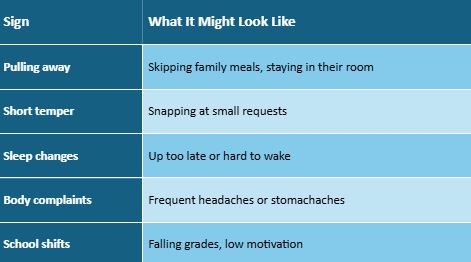
If a few of these feel familiar, pay closer attention.
The Mind Body Bridge: How the Body Holds Stress?
My work looks a bit different here. Emotional regulation is not just a mind task. It lives in the body too. A racing heart. A tight jaw. A stomach in knots. These are not side effects of stress. They are the stress itself.
Tuning into your body’s wisdom means learning the language of body sensations. Try this together. Notice three spots in the body holding tension. Take one slow breath into each spot. Small. Simple. It often works well.
What Are Practical Coping Skills for Teens?
Coping skills for teens work best when they are simple. Not just ideas on paper, but tools they can use at the moment.
Grounding Practices to Explore
- Name five things they can see, four they can hear, three they can touch.
- Press both feet into the floor and feel the ground hold them.
- Run cold water over the wrists to break a stress spiral.

Naming Emotions Builds Emotional Intelligence for Teens
A teen who can say “I feel anxious, and a bit upset too” has more control than one who only says, “I feel bad.” This builds real emotional intelligence for teens. Do it with no judgment, just curiosity.
Movement as a Regulation Tool
Stress management for teens often skips one fact. The body needs to move. A short walk. A dance break. Even shaking out the hands for thirty seconds can shift a stuck nervous system.
How Can Parents Support Their Teen’s Emotional Development?
Positive parenting during the teen years looks less like solving. It looks more like walking alongside. One mom I worked with used to solve every problem her son brought home. She tried something new. Before giving any advice, she started saying, “that sounds really hard.” Her son began talking to her more, not less.
A few tools to help create safety at home:
- Listen first. Offer advice second, and only if asked.
- Say your own feelings out loud, like “I feel frustrated, so I need a minute.”
- Keep small daily rhythms, like family dinner or a quick check in.
Family support for teenagers does not need to be perfect. It needs to be steady.
Building Self Esteem and Confidence in Teens
Self-esteem in teenagers grows through real life, not empty praise. Building confidence in teens means letting them face things they can handle. It might be a hard talk with a friend. It might be a tough class.
Small steps on their own add up fast. Let your teen plan their own weekend project. That teaches more about their own strength than any pep talk ever could.
When Does Teen Stress Cross Into Anxiety?
Some stress is a normal part of adolescent emotional development. Anxiety in teens becomes a bigger concern when worry starts blocking daily life. Watch for sleep loss, pulling away from friends, or school struggles that last for weeks, not just a day or two.
You do not need to wait for a crisis to reach out. Early, curious attention helps most. Waiting rarely helps on its own.
You Do Not Have to Navigate This Alone!
Building emotional resilience in teenagers is not a straight path. No parent needs to walk through this situation alone. Sometimes home support is not quite enough on its own. A therapist who gets the teen nervous system can help. At Gabriela Breton Psychotherapy , I offer a space for teens to explore their feelings with curiosity, not judgment, one breath, one moment, and one step at a time. Reach out through gabriela-breton.com to talk about support for your family.
Latest Post
- Understanding Anxiety: How I Help Teens and Adults Work With the Mind and Body
- Understanding the ADHD Brain: Beyond Attention and Hyperactivity
- Why Life Transitions Can Feel Overwhelming for Teens—and How Therapy Helps
- Is Your Teen Struggling Emotionally? Here’s How to Build Lasting Resilience
- Trauma Sensitive Yoga: How Mindful Movement Helps Your Nervous System Feel Safe
- Couples Therapy: Strengthen Communication, Rebuild Trust & Reconnect
- Ketamine Assisted Psychotherapy: A Gentle Path Through Depression, Anxiety, and Trauma
- Beyond the Couch: How My Teen Therapy Can Help You Navigate Life
- How I Work With Individual Therapy Clients: Beyond Talk Therapy